Bedding Materials · Practical Guide
How Wool Fill Changes the Feel of a Bed: Loft, Care, and Trade-Offs
Wool has a particular way of meeting the body: springier and more substantial than down, less yielding than many loose-fill alternatives. Its moisture-managing qualities can make it appealing in bedding, but the experience depends on how the wool is constructed, how the pillow is maintained, and what kind of support feels comfortable to you.
A pillow can look simple from across the room. Under its cover, however, the filling determines how it compresses, how it rebounds, how much warmth it holds, and how often it needs attention. Wool is not merely another soft stuffing. Its fibers form a resilient, layered structure that creates a distinctive combination of cushioning and lift.
That character is easy to misread if the only measure is softness. A wool pillow may feel gentle on the surface yet comparatively firm underneath. It may settle with use without behaving like a pillow that has simply gone flat. And although wool is often associated with natural temperature and moisture management, it is not automatically cool, washable, or suitable for everyone.
Understanding the material means looking past broad promises and asking practical questions: Is the fill layered batting or loose clusters? Can the loft be adjusted? What does the care label permit? And how might the pillow feel after several months of nightly use? Those details matter more than the word “wool” alone.
The feel: springy, grounded, and less cloudlike
Wool fill tends to offer a springy, substantial hand. Press a pillow and it may compress, then push back with a measured resilience. Compared with down, which is prized for a light, billowy softness and easy compression, wool often feels more structured. It can cradle the head while retaining a sense of support beneath it.
That distinction is not a simple contest between soft and firm. The feel comes from several interacting factors: the amount of fill, the way fibers are processed, the arrangement of the filling, the fabric of the shell, and the dimensions of the pillow. A dense pillow made with layered wool batting may feel quite different from one filled with fluffy wool clusters. A tightly woven cover can also make the surface seem firmer than a more flexible shell.
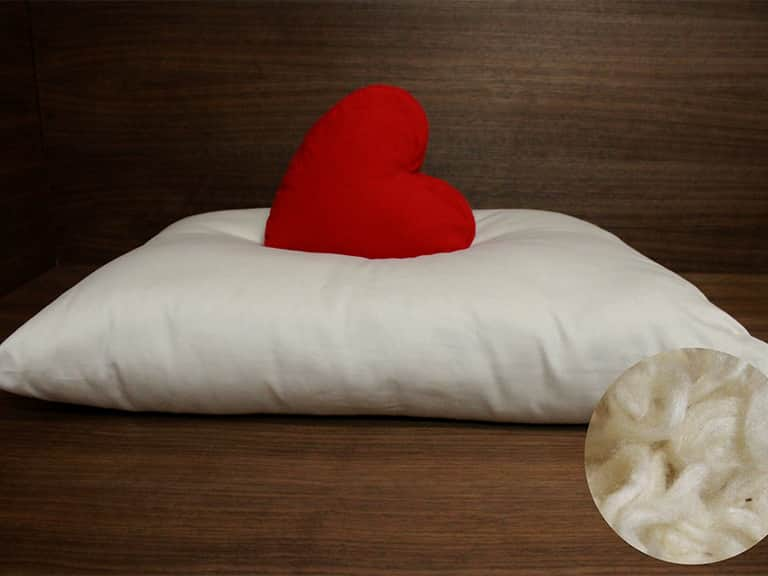
Some wool pillows are built in layers. These layers create an even surface and a more cohesive, mattress-like structure inside the pillow. Other designs use wool clusters or bolus: small, springy forms of wool intended to create a softer, more adaptable fill. Neither construction is universally better. Layers can appeal to people who prefer a steady, organized feel; clusters may suit those looking for a looser, more pliable pillow.
Construction also affects how a pillow responds when the sleeper moves. A resilient fill can recover its shape after pressure, but it will not necessarily flow around the head in the same way as down or finely shredded material. If a pillow is adjustable, the fill may be redistributed or removed to alter its height. If it is not, the initial loft and firmness become more important choices.
Loft is a question of alignment, not height alone
Loft describes a pillow’s height, but the useful question is how that height supports the head and neck in a particular sleeping position. A tall pillow is not automatically supportive, and a low pillow is not automatically gentle. The right loft depends on body shape, mattress feel, shoulder width, and whether someone sleeps mainly on their side, back, or stomach.
Side sleepers often need enough height to bridge the space between the mattress and the head without angling the neck upward or downward. A resilient wool fill may provide a stable base, but a pillow that is too high or too low can still feel uncomfortable. Back sleepers generally need a shape that supports the natural curve of the neck without pushing the head too far forward. Stomach sleepers often find lower, softer pillows more comfortable, though personal preference and body mechanics vary.
Wool’s response can make these distinctions feel especially noticeable. It may have less of the sinking, enveloping sensation associated with down, yet more give than a rigid support. For some, that balance feels reassuring. For others, it can seem too firm or too resistant to shaping. The only reliable test is how the pillow holds the head in the position used most often, not how plush it feels when squeezed in a store or opened from packaging.
Adjustable construction offers a way to refine that fit. A zippered pillow may allow a sleeper to remove some filling, reducing height and density. The adjustment is useful, but it is not a substitute for understanding the fill: removing wool can change both loft and the pillow’s overall feel. It may also take more than one trial to find a comfortable amount. Keep removed fill clean and dry if the design allows it to be stored, and follow the maker’s instructions.
Wool can settle with regular use, particularly in pillows made from layered batting. Some settling is a normal change in the material’s profile, rather than evidence of immediate failure. For example, descriptions of hand-built wool pillows may note that the fill can settle by roughly 15 to 30 percent in the first months of use. That figure is product-specific, not a universal promise or rule. Check the manufacturer’s guidance for the particular pillow, and consider expected settling when deciding how much initial loft is appropriate.
Moisture management—and what it does not mean
Wool is often selected for its ability to interact with moisture and help regulate the sleeping environment. That can matter to people who dislike the clammy feeling of damp bedding or who want a filling that does not feel as enclosed as some dense foams. Wool’s fibers and the air spaces between them contribute to the way it handles warmth and moisture.
But “moisture managing” is not the same as waterproof, sweat-proof, or immune to odors. A pillow still collects moisture from its surroundings and from normal nightly use. The shell, pillowcase, bedroom humidity, ventilation, and laundering habits all influence how fresh it remains. Wool should not be treated as a material that never needs airing or protection.
Nor does natural fiber automatically mean a cooler sleep. Temperature comfort is personal and depends on the entire bedding system. A heavy cover, a warm room, a thick pillowcase, or individual heat sensitivity can outweigh the properties of the fill. A breathable cover and regular use of a washable pillowcase or protector can help manage everyday soil and moisture, provided those layers do not make the pillow uncomfortably warm.
For people considering wool because of sensitivities, it helps to separate material preference from medical advice. The word “natural” does not guarantee that a product will suit every person, and claims such as “hypoallergenic” should be interpreted cautiously. Anyone with a known allergy, asthma concern, skin sensitivity, or other medical issue should review the product’s complete materials and seek appropriate professional guidance when needed.
Care begins with the label
Wool care is less uniform than the material’s reputation suggests. Some wool pillows are designed to be machine washed; others are spot-clean only. The distinction can depend on the wool processing, fill construction, shell, and how the pillow is assembled. A general rule found on one product cannot safely be applied to another.
Start with the care label or manufacturer’s instructions. If the pillow is not washable, do not assume that a gentle cycle will be harmless. Excess water, agitation, or high heat can alter the fill, damage the shell, or make the pillow difficult to dry thoroughly. If only the cover is removable and washable, take care not to wet the inner pillow while laundering it.
- Use a pillowcase or protector. A washable outer layer can limit contact with skin oils, dust, and everyday spills. Choose one that fits without compressing the pillow excessively.
- Follow spot-cleaning guidance. If the instructions permit spot cleaning, use only the recommended method and avoid soaking the fill.
- Dry thoroughly. Any dampness left inside can create an unpleasant environment. Follow the maker’s drying directions and do not return a pillow to use until it is fully dry.
- Air it when appropriate. Gentle airing may help refresh bedding, but direct sun or intense heat should be avoided unless the manufacturer explicitly says otherwise.
- Wash removable covers separately. Check the fabric’s instructions; shell and fill can have different care requirements.
The practical trade-off is clear: wool may suit someone willing to protect the pillow and follow specific care instructions, but it is not always the easiest choice for households that require frequent full-pillow washing. If machine-washability is essential, verify that feature before purchasing rather than relying on assumptions about natural fibers.
Wool compared with down, kapok, and foam
Material comparisons help clarify preference, but they cannot predict comfort perfectly. Two pillows made from the same broad category may still feel unlike one another because their fill, cover, and construction differ.
| Fill type | Common feel | Questions to consider |
|---|---|---|
| Wool | Springy, substantial, and relatively structured | Is the fill layered or loose? Can the loft be adjusted? Is it washable? |
| Down | Light, lofty, and readily compressible | Do you prefer a soft, yielding feel? What are the care and sourcing details? |
| Kapok | Light and buoyant, with a softer plant-fiber character | Can filling be removed? Does the product require spot cleaning only? |
| Latex or foam | More responsive or contouring, depending on solid or shredded construction | Is the support too firm or warm for you? What cleaning method is permitted? |
Down offers a markedly different experience for people who value soft compression and a lighter, cloudlike surface. Some down pillows are designed with chambers to help maintain shape; others are intended to feel low and yielding. Wool, by contrast, often feels more spring-loaded and grounded. A pillow description for a down insert, for example, may note that it arrives lofty and compresses to its working thickness with use. That shift is part of its expected behavior, just as some wool fills may settle as their layers are used.
Kapok is another natural fill, but its feel is generally lighter and more buoyant. Some kapok pillows have zippers that allow the sleeper to adjust the amount of fill. Care may be restrictive: a product can specify spot cleaning and advise against washing the pillow. The category label alone does not settle the question, so the care instructions remain essential.
Latex brings a different kind of resilience. A solid latex pillow has a continuous core, while shredded latex allows more movement among pieces and may be adjustable. Wool and latex can both feel supportive, but their structures and responses are not interchangeable. People exploring latex bedding should also check relevant material sensitivities and handling guidance, especially because natural latex is not appropriate for everyone.
The trade-offs behind the appeal
Wool’s strengths—resilience, a substantial feel, and moisture-management qualities—come with practical considerations. It may be heavier or less cloudlike than a down pillow. A fixed-fill design offers fewer opportunities to customize loft. Some pillows need spot cleaning rather than routine machine washing, and layered wool may settle over time. Those are not defects by themselves; they are conditions to weigh against the comfort and maintenance preferences of a household.
There is also a sourcing question. “Wool” tells a reader what broad fiber is present, but not where it came from, how it was processed, or whether a certification applies to the fill, the fabric, or both. If provenance or production standards matter to you, look for specific information and verify what the certification covers. A broad environmental claim is not a substitute for transparent material details.
Likewise, “natural” does not mean impact-free. Animal fibers have supply chains and land-use considerations; synthetic foams and fibers have their own material and end-of-life questions. The most useful comparison is specific: identify the fill, cover, origin, care requirements, expected lifespan, and disposal options where available. Avoid treating a single adjective as a complete account of environmental performance.
A practical checklist before choosing
A pillow decision becomes easier when preference is translated into a short set of questions. Instead of asking whether wool is “best,” ask whether the design suits the way you sleep and the level of maintenance you can reasonably provide.
- What position do you sleep in most often? Use your usual position as the starting point for evaluating loft and support.
- Do you like a springy or compressible feel? Wool generally feels more substantial than down, though construction changes the experience.
- Can you adjust the fill? A zipper may permit loft changes, but check whether fill removal is intended and how to store extra material.
- What happens after settling? Read product-specific guidance about expected changes in height or density.
- How is it cleaned? Confirm whether the entire pillow, only the cover, or neither can be washed.
- What is inside the cover? Check the shell, inner casing, fill composition, and any blends rather than relying on the product name.
- Are there sensitivities to consider? Review all materials and seek qualified advice where a health concern is involved.
A material choice, not a promise of perfect sleep
Wool changes the feel of a bed by bringing a particular kind of support: springy, steady, and more substantial than the airy softness many people associate with down. Its relationship with moisture can be attractive, and its resilience may appeal to sleepers who dislike a pillow that collapses quickly. But the result is shaped by construction, loft, cover, and care—not by fiber name alone.
The best wool pillow is therefore not the one with the most sweeping claims. It is the one whose height suits the sleeper, whose feel matches personal preference, and whose upkeep fits ordinary life. Read the care label before the first night. Look closely at how the fill is built. Allow for the possibility of settling, and be candid about whether you prefer a pillow that yields softly or pushes back.
That is a quieter way to choose bedding, but a more useful one. A pillow does not need to promise transformation. It needs to support a comfortable position, behave as expected, and remain manageable long after the packaging is gone.